
“Should I just replace it?” is the question we hear more than almost any other, usually from someone standing in front of a window or door that’s been giving them trouble for months. It’s a fair question, and it deserves a real answer instead of a sales pitch, so here’s the actual thinking we use.
Start with the rule of thumb: if repairing a window or door is going to cost more than roughly half of what a full replacement would run, replacement is usually the better value. Below that line, repair almost always wins, because it costs less, takes less time, and doesn’t disturb the trim, siding, or interior finish around the unit. That last part matters more than people expect. A replacement isn’t just the cost of the new window or door — it’s often patching drywall, repainting trim, and dealing with a day or two of a hole in your house.
The harder question is figuring out which side of that line you’re actually on, and that comes down to three things more than anything else.
The first is whether the problem is one part or the whole system. A cracked pane, a failing lock, a worn sweep, a rotted piece of trim — these are component failures, and they’re almost always repairable at a fraction of replacement cost. A rotted sill, a frame that’s shifted out of square, or a seal that’s failed throughout the entire unit is a different story, because at that point you’re not fixing a part, you’re fixing the structure the rest of the unit depends on.
The second is age and remaining life. A 10-year-old window with one bad component still has years of life left in the rest of it. A 40-year-old window with the same problem may be showing you its first sign of a system that’s simply reaching the end of its usable life.
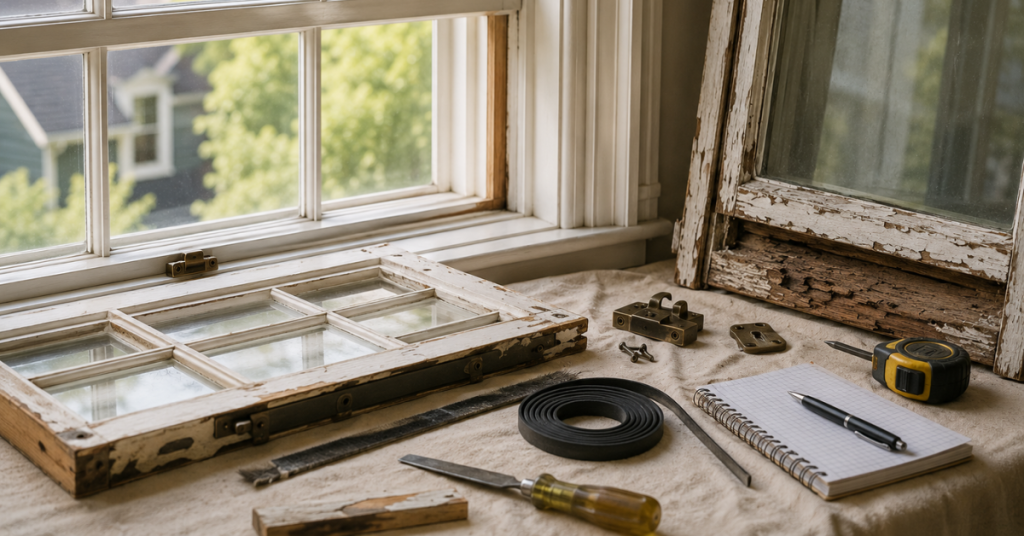
The third, especially relevant in a city with as much older housing stock as Ann Arbor, Ypsilanti, and Saline, is what you’d be giving up. Original wood windows and doors carry proportions, trim details, and craftsmanship that isn’t cheap or easy to replicate. That’s not sentimental — it’s a real cost, because matching that character in a replacement unit usually costs more than a standard option.
We built our process around answering these three questions honestly before recommending anything. A lot of the time, that means a repair. Sometimes it means telling a homeowner that replacement really is the better long-term move. Either way, the goal is the same: you should understand exactly what you’re paying for and why, before you decide.